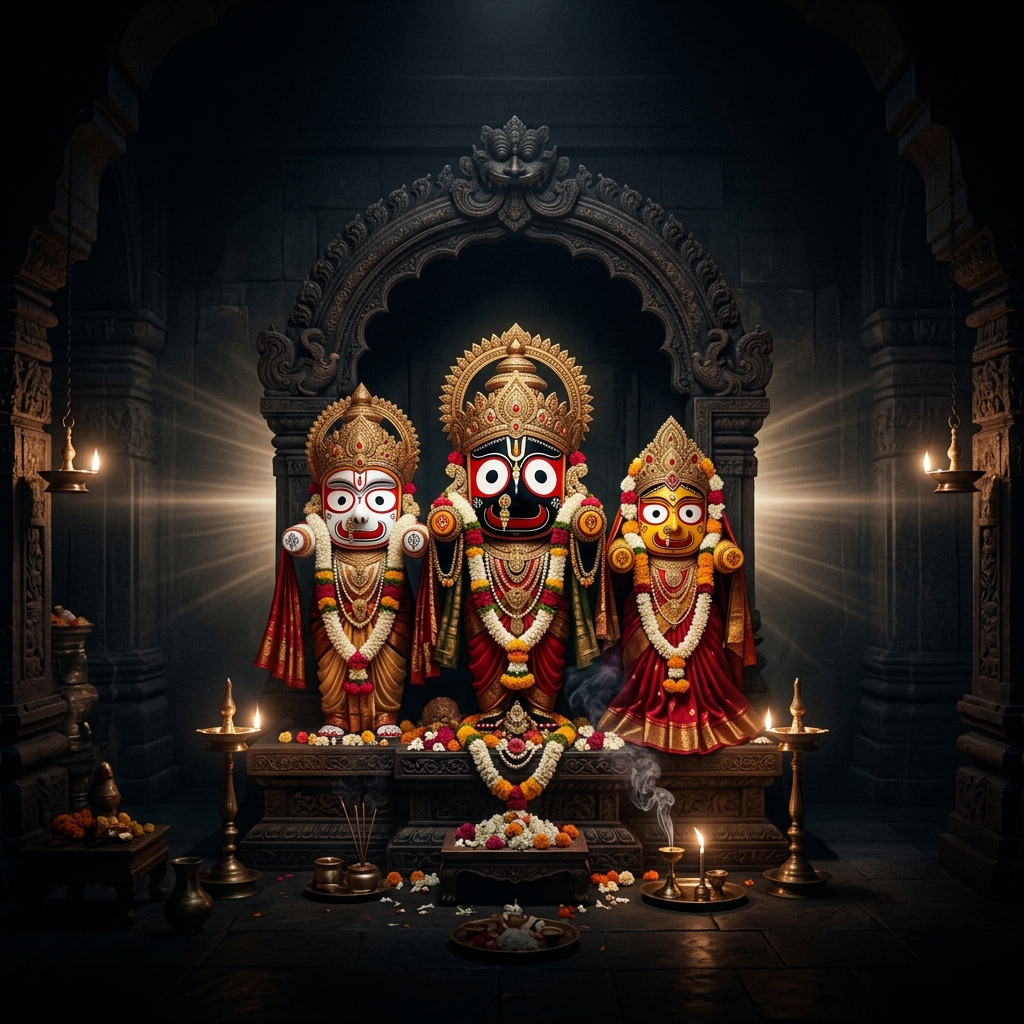
The spiritual landscape of Puri was forever transformed in the 16th century with the arrival of the great saint and social reformer, Sri Chaitanya Mahaprabhu. His presence catalyzed the Bhakti (devotion) movement in Odisha, infusing the ancient cult of Jagannath with deep emotional ecstasy and unparalleled devotion.
The Arrival of Chaitanya Mahaprabhu
Born in Navadwip, Bengal, Chaitanya Mahaprabhu abandoned a life of scholastic brilliance to embrace Sannyasa (renunciation) at a young age. He traveled to Puri, drawn by an irresistible, mystic pull toward Lord Jagannath, whom he viewed as the ultimate manifestation of Krishna.
When Chaitanya first entered the Shree Mandira and laid eyes on the deity, it is recorded that he fell into a deep trance, overwhelmed by Mahabhava - the highest state of spiritual ecstasy. He was rescued and cared for by Sarvabhauma Bhattacharya, the chief scholar of the Gajapati King, who was eventually converted by Chaitanya from a strict Advaita Vedantin into a passionate devotee of Krishna.
Sankirtana and Emotional Devotion
Before Chaitanya, worship in the Jagannath Temple was largely dominated by rigid Agamic rituals, mantras, and complex Tantric traditions. The Bhakti movement democratized this spiritual space.
Chaitanya introduced Nama Sankirtana - the congregational chanting of the holy names of God, particularly the Hare Krishna mantra, accompanied by the playing of cymbals (kartalas) and drums (mridangas). This ecstatic singing and dancing broke down social barriers. Devotion was no longer about learning Sanskrit verses or performing expensive fire sacrifices; it was about the purity of the heart.
The Unifying Force
The Bhakti movement under Chaitanya Mahaprabhu reinforced the egalitarian roots of Jagannath Tattva. Kings, scholars, weavers, and outcasts all danced together in the Bada Danda (Grand Road) during Rath Yatra.
Chaitanya spent his final 24 years residing in Puri at the Gambhira (a small room in the Radhakanta Matha), absorbed in the divine mood of Radha longing for Krishna. His deep philosophical realization established Lord Jagannath not just as the King of the Universe, but as the supreme object of sweet, intimate, and unconditional love.