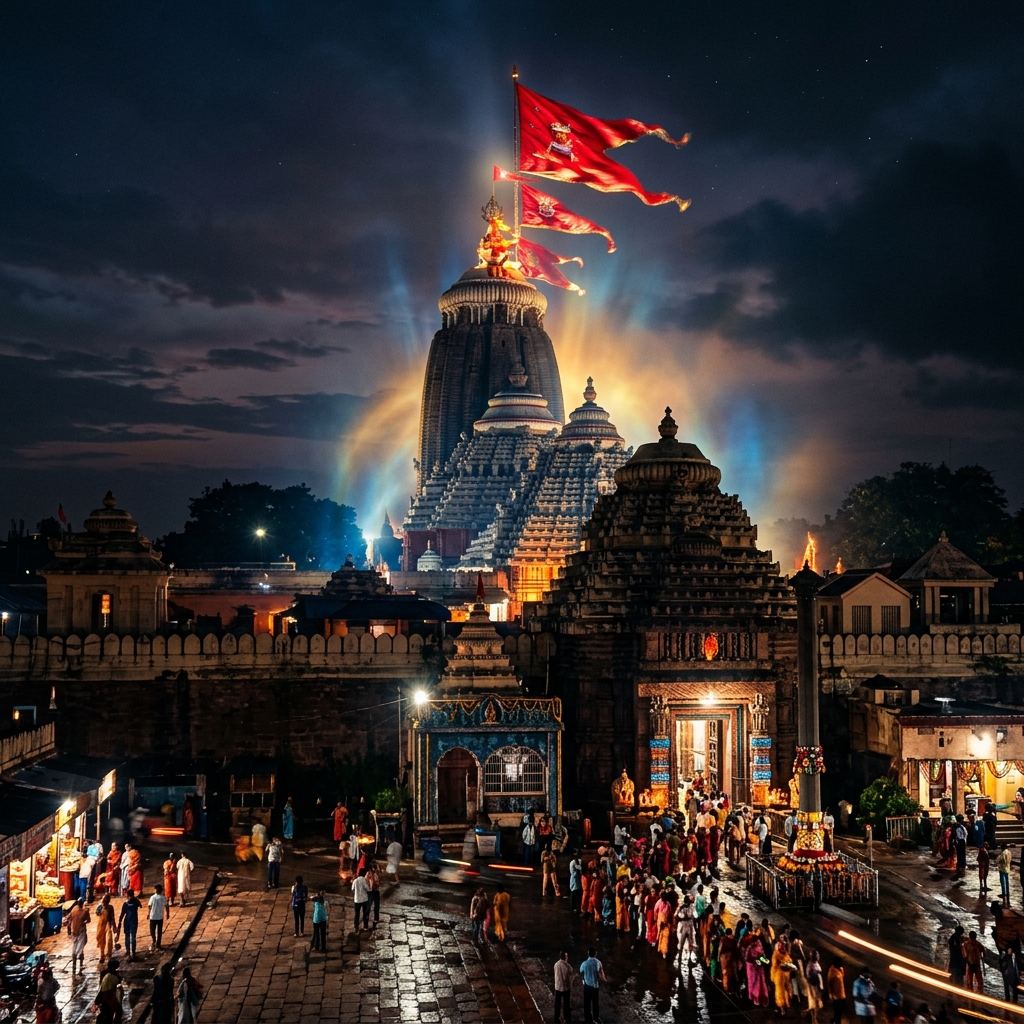
Stretching approximately 3 kilometers from the Singha Dwara (Lion's Gate) of the Shree Mandira to the Gundicha Temple, the Bada Danda (Grand Road) is the widest and perhaps the most spiritually significant street in Odisha. It is the earthly pathway of the Lord of the Universe.
The Chariot's Path
The primary purpose of the Bada Danda is to serve as the route for the annual Rath Yatra. To accommodate the three massive wooden chariots - Nandighosha, Taladhwaja, and Darpadalana - and the millions of devotees who gather to pull them, the road was designed to be exceptionally wide.
During the festival, the Bada Danda transforms into an ocean of humanity. It is here that the core philosophy of the Jagannath cult - absolute equality - is most visible. On this road, there is no distinction between a king and a beggar, a Brahmin and an outcast. Everyone rubs shoulders, shares space, and pulls the same ropes to move the Lord forward.
The Mathas of Bada Danda
Historically, the Grand Road was flanked by numerous Mathas (Hindu monasteries) belonging to various sects like the Ramanandi, Gaudiya, and Dashanami traditions. These Mathas were established by saints and kings over centuries to provide shelter to pilgrims, offer free food, and perform specific ritualistic duties (Sevas) for Lord Jagannath during festivals.
For instance, the Emar Matha and the Bada Oriya Matha held massive influence and wealth, acting as key socio-religious institutions. During the Rath Yatra, the heads of these Mathas offer special Panti Bhoga (offerings) to the deities right on the chariots.
The River of Dust
In the Odia devotional tradition, the dust of the Bada Danda is considered highly sacred. It is believed that because Lord Jagannath Himself traverses this road, and because millions of pure-hearted saints and devotees have walked it over millennia, the dust (Raja) is infused with divine energy.
Even today, you can witness devotees rolling on the dust of the Bada Danda or smearing it on their foreheads as a mark of supreme humility. The Grand Road is not just a physical street; it is a flowing river of devotion that connects the main temple to the birthplace of the Lord.