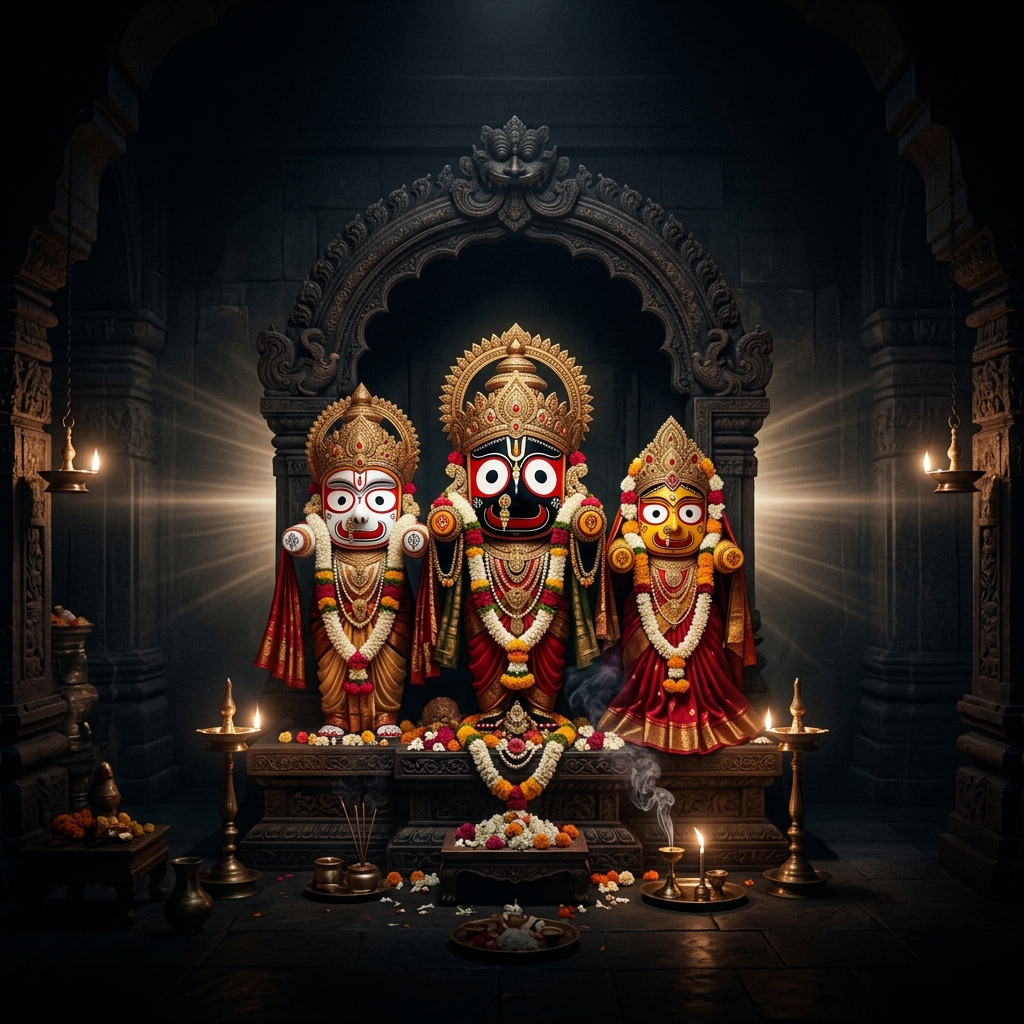
Of all the legendary devotees of Lord Jagannath, perhaps none embodies the universal, boundary-breaking nature of the Jagannath Tattva quite like Salabega (or Bhakta Salabega), a 17th-century Muslim poet.
The Son of a Mughal Subedar
Salabega was born to a Muslim father (Lalbeg, a Mughal subedar or military commander) and a Hindu Brahmin mother who had been abducted by Lalbeg. Because of his parentage, Salabega was ostracized by orthodox Hindu society and strictly denied entry into the Shree Mandira.
According to legend, as a young man, Salabega was severely wounded in a battle and suffered from a supposedly incurable ailment. His mother, retaining her faith, urged him to pray to Lord Krishna (Jagannath) for a cure. With nowhere else to turn, Salabega prayed with intense devotion, and miraculously, he was completely healed.
The Devotion That Stopped the Chariot
Following his miraculous recovery, Salabega dedicated his entire life to Lord Jagannath. Since he was not allowed inside the temple, he would stand outside the Lion's Gate (Singha Dwara) or gaze at the Neelachakra (the blue wheel atop the temple) from afar.
His most famous legend occurred during the annual Rath Yatra. Salabega had gone to Vrindavan and fell ill on his way back. He was desperate to reach Puri in time to see the Lord on His chariot, as this was the only time he was allowed to see the deity up close. Realizing he wouldn't make it in time, he prayed tearfully, begging the Lord to wait for him.
Miraculously, the massive chariot of Lord Jagannath, the Nandighosha, suddenly stopped moving. Thousands of devotees and even elephants could not pull it an inch further. The chariot stood frozen on the Grand Road until Salabega finally arrived days later, weeping and offering his prayers. Only after Salabega received his Darshan did the chariot begin to roll again.
The Enduring Legacy
Salabega composed numerous devotional songs (Bhajans) in Odia, filled with profound longing, surrender, and philosophical depth. His most famous bhajan, "Ahe Nila Saila" (O Great Blue Mountain), is considered a masterpiece of Odia literature and is still sung daily by millions of devotees and temple servitors.
Today, Salabega's samadhi (tomb) is located right on the Grand Road in Puri. In a beautiful tribute to his devotion, the chariots during the Rath Yatra still pause briefly near his tomb to honor the Muslim devotee whose love was so strong it stopped the Lord of the Universe.