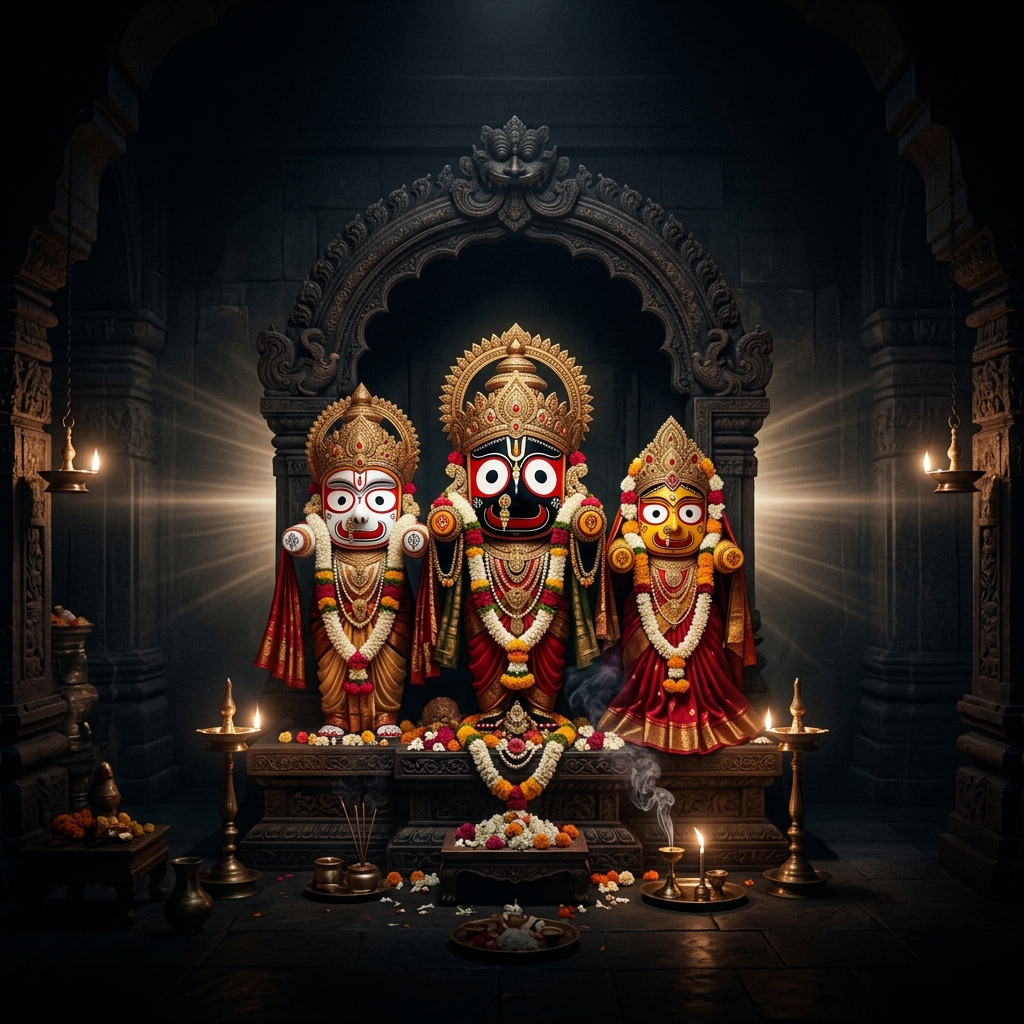
Puri is not just a city built around a temple; it is a meticulously designed spiritual landscape. In Hindu cosmology and ancient scriptures like the Skanda Purana, the sacred geography of Puri is described as Sankha Kshetra, or the Conch Shell region.
The Shape of the Conch
Lord Vishnu is traditionally depicted holding four items: the conch (Sankha), the discus (Chakra), the mace (Gada), and the lotus (Padma). Correspondingly, the great pilgrimage sites of ancient Odisha were mapped to these symbols. Puri is the Sankha Kshetra, Bhubaneswar is the Chakra Kshetra, Jajpur is the Gada Kshetra, and Konark is the Padma Kshetra.
The layout of Puri mimics the spiral shape of a right-handed conch shell (Dakshinavarta Sankha), which is considered extremely auspicious. The city is geometrically divided into different zones, each assigned to various deities, making the entire geography of the town a massive, living mandala.
The Anatomy of the Kshetra
The Sankha Kshetra spans an area roughly resembling a triangle with its base touching the Bay of Bengal.
- The Apex (Head of the Conch): The western tip of the conch is marked by the sacred Lokanath Temple, dedicated to Lord Shiva. Shiva acts as the guardian (Kshetrapal) of the realm.
- The Navel (Center of the Conch): The very center, or the navel, is where the main sanctum (Garbhagriha) of the Shree Mandira is located. This is the seat of the Chaturdha Murti (the four-fold deities: Jagannath, Balabhadra, Subhadra, and Sudarshana).
- The Base (Mouth of the Conch): The mouth of the conch opens towards the eastern sea, where the Swargadwara (The Gateway to Heaven) cremation ground is located.
Unity in Diversity
The sacred geometry of Sankha Kshetra is a profound example of religious synthesis. The conch itself is a Vaishnava symbol, yet the tip of the conch is guarded by Lord Shiva (Lokanath). The region is dotted with eight powerful Shiva shrines (Ashta Shambhu) and eight powerful Goddess shrines (Ashta Chandi).
This layout reinforces the central philosophy of Jagannath Tattva - that Jagannath is not just a sectarian deity of the Vaishnavas, but the Supreme Godhead unifying all major paths of Hinduism, including Shaivism and Shaktism. To walk the streets of Puri is to walk through a carefully mapped cosmic diagram designed to lead the soul to the center: Lord Jagannath.