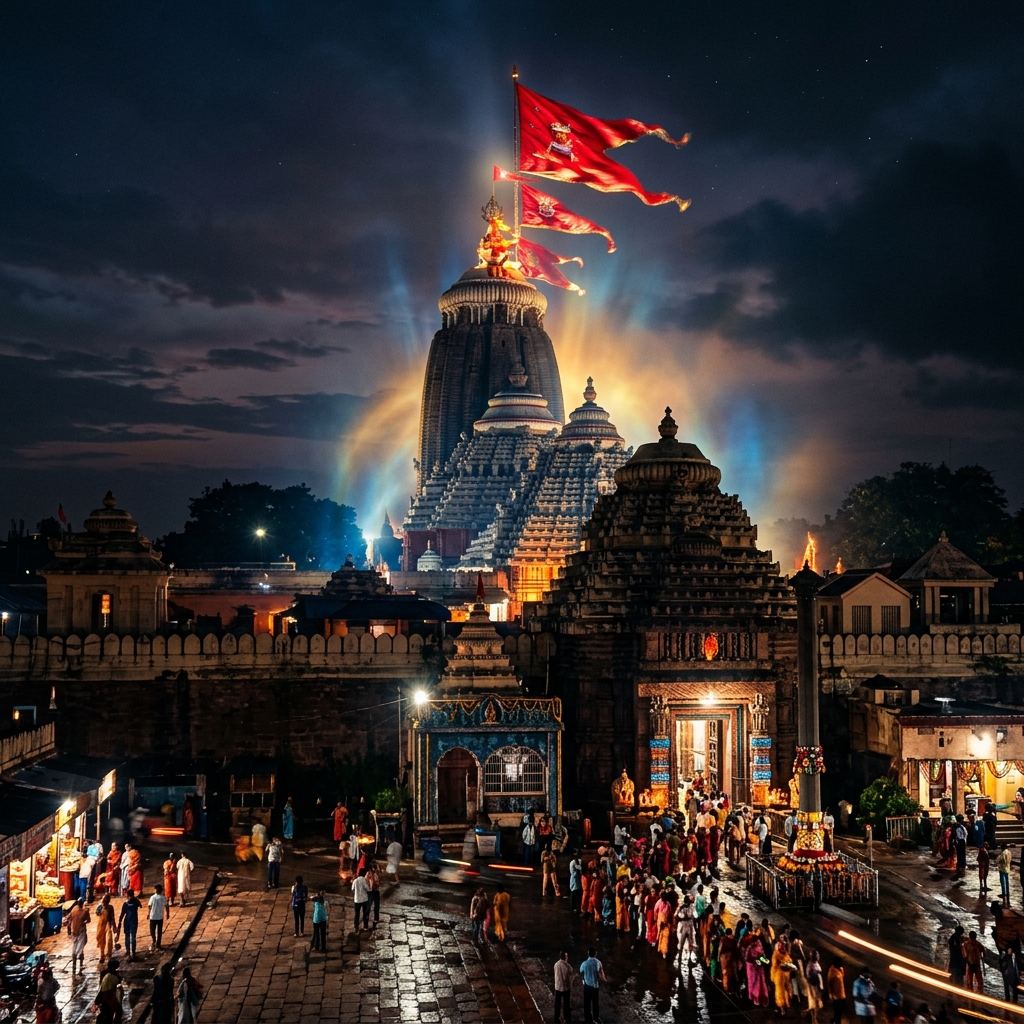
The origin story of Lord Jagannath in Puri is inextricably tied to the legendary King Indradyumna, a deeply pious monarch of the Malava kingdom whose capital was Avanti (modern-day Ujjain). His quest to find the ultimate manifestation of God forms the bedrock of the Jagannath Tattva.
The Quest for Nila Madhava
According to the Skanda Purana, King Indradyumna was consumed by a desire to see Lord Vishnu in His most perfect, physical form. He dispatched priests in all directions to find this deity. The priest Vidyapati, sent to the East, discovered that a tribal chief named Vishwavasu was secretly worshiping a radiant blue stone deity named Nila Madhava in a dense forest.
Vidyapati managed to locate the deity with the help of Vishwavasu's daughter, Lalita. However, when King Indradyumna arrived with his massive army to claim the deity, Nila Madhava had miraculously vanished. A divine voice (Akashvani) informed the heartbroken king that he would never see the Lord as Nila Madhava again. Instead, the Lord would appear in a new, wooden form.
The Floating Daru
Instructed by the divine voice, King Indradyumna waited by the sea at Puri. Soon, a massive, fragrant log of Neem wood (Daru Brahma) with divine markings floated ashore at Banki Muhana. No human could move the heavy log until King Indradyumna requested the tribal chief Vishwavasu and the Brahmin Vidyapati to lift it together - a powerful symbol that the Lord belongs equally to all classes of society.
The Mysterious Carpenter
Once the log was brought to the temple site, the king needed a master artisan to carve the idols. An old, mysterious carpenter - believed to be Lord Vishwakarma or Lord Vishnu himself in disguise - appeared and agreed to carve the idols on one strict condition: he must be locked inside a room with the wood for 21 days, and no one must open the doors or disturb him.
The king agreed. For many days, the sounds of chiseling could be heard. However, after about two weeks, the sounds stopped. Fearing the old man had died of hunger or exhaustion, Queen Gundicha pleaded with the king to open the doors. Overcome by anxiety, the king breached the agreement and opened the doors early.
The Incomplete Deities
Inside, the carpenter had vanished. Left behind were three massive, unfinished wooden deities - Lord Jagannath, Lord Balabhadra, and Devi Subhadra. They had no hands, no feet, and uncarved bodies.
King Indradyumna was devastated, believing he had ruined the divine plan. However, a divine voice reassured him that this "incomplete" form was exactly how the Lord intended to be worshiped in the Kali Yuga. The formless void (Shunya Brahma) had taken this symbolic, stump-like shape to show that the Divine sees all without physical eyes, and embraces the universe without physical arms.