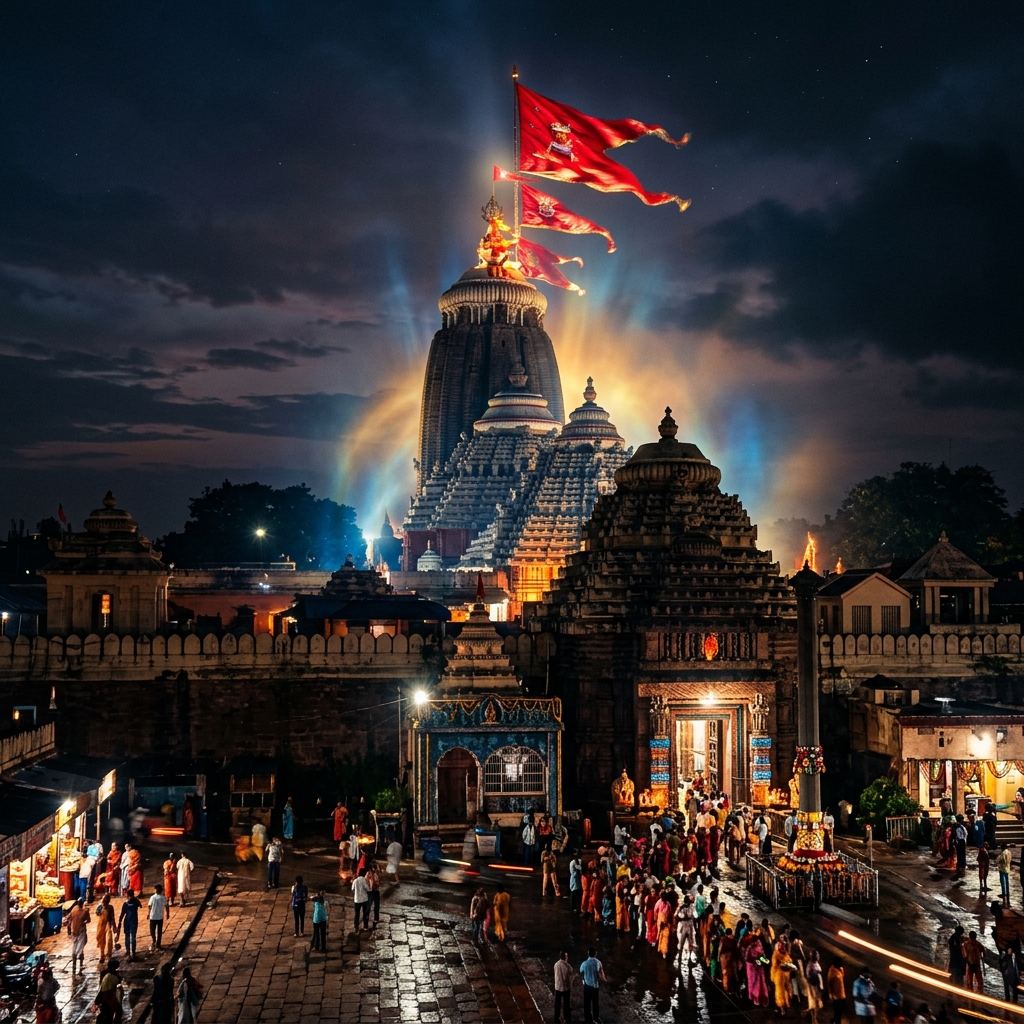
The history of the Shree Jagannath Temple is not just one of grand festivals and elaborate rituals; it is also a story of immense sacrifice, desperate flights, and fierce protection. The temple's immense wealth and its status as the heartbeat of Hindu Odisha made it a prime target for invaders. Over a span of roughly 400 years, the temple was attacked nearly 18 times.
The Strategy of Concealment
Unlike stone idols in other Hindu temples that were easily smashed by iconoclasts, the deities of Puri are made of wood (Daru). This made them both vulnerable to fire but also, crucially, highly portable.
The Gajapati Kings and the devoted sevayats (servitors) developed a standardized protocol for invasions: whenever an enemy army breached the borders of Odisha and headed for Puri, the primary objective was not to defend the temple building, but to protect the Brahma (the divine life force) within the wooden idols. The deities would be hurriedly mounted on carts or boats and smuggled out of the city under the cover of darkness.
The Flight to Chilika Lake
The vast, labyrinthine waters of Chilika Lake served as one of the most reliable hiding spots for the deities. Its numerous isolated islands, dense reed beds, and shifting water channels made it nearly impossible for invading armies (who were unfamiliar with the terrain) to track the boats.
Islands like Gurubai, Chikili, and Nairri in Chilika Lake served as secret sanctuaries where the deities were hidden for months, and sometimes years. The servitors would live in hiding with the deities, performing abbreviated [niti](/history/daily-rituals-daily-rituals-niti)|daily rituals]] in secret to ensure the Lord's worship was never entirely halted.
The Attack of Kalapahada
The most devastating of these invasions was by the Afghan general Kalapahada in 1568. The Gajapati empire had fallen, and the defense of Puri crumbled. The sevayats managed to smuggle the deities to an island in Chilika, but Kalapahada's spies tracked them down.
In a tragic turn of events, Kalapahada seized the wooden deities and took them to the banks of the river Ganga, where he set them on fire. A brave devotee named Bisar Mohanty, disguised as a beggar, followed the army. When the fire died down, he sifted through the ashes and miraculously recovered the unburnt Brahma (the sacred core). He hid the Brahma inside his drum (Mridanga) and smuggled it back to Odisha.
It was later installed into new wooden bodies by King Ramachandra Deva of Khurda, restoring the cult of Jagannath.
The Resilience of Faith
The empty Shree Mandira during these periods of invasion was a symbol of deep mourning for the Odia people. Yet, the ability to move the deities and protect their core essence ensured that the Jagannath Tattva could never be truly destroyed by any army. The temple stones could be broken, but the Lord of the Universe was kept safe by the unyielding devotion of His people.