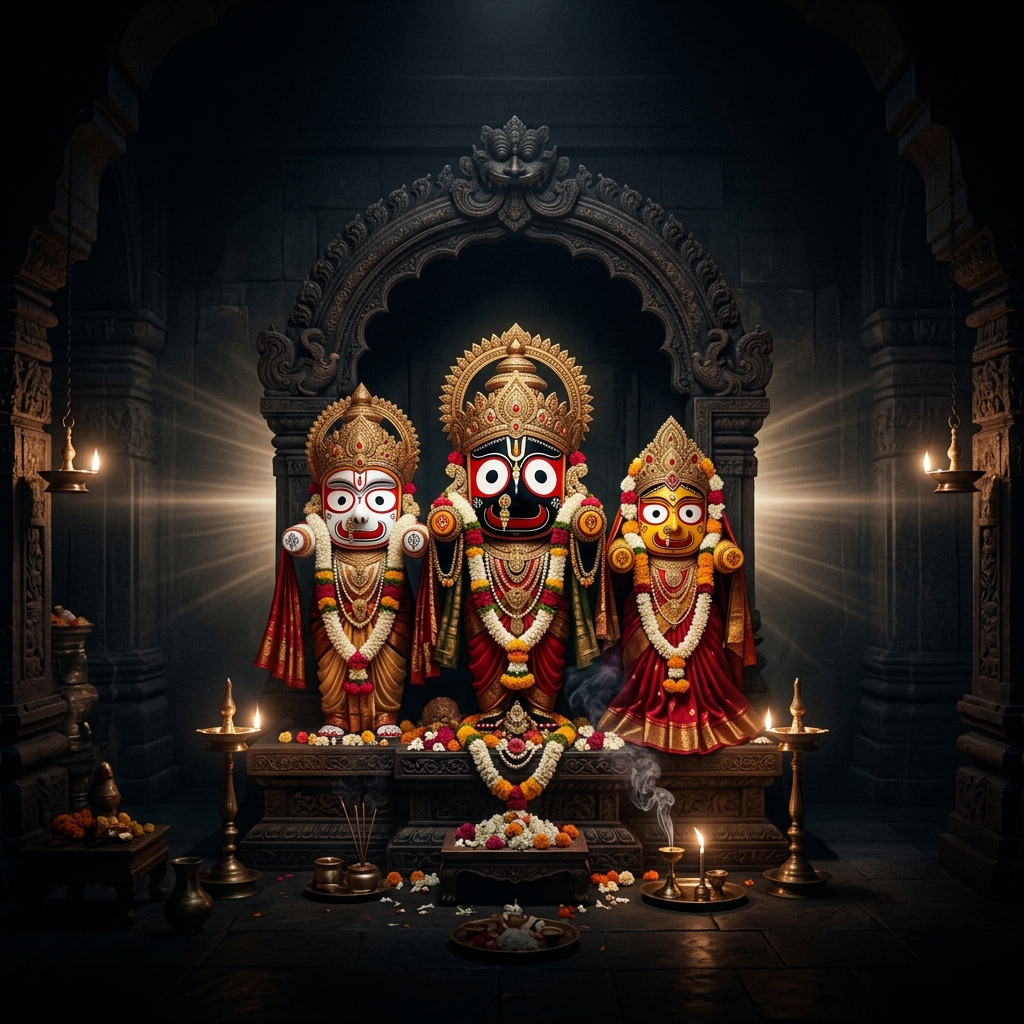
The Concept of Daru Brahma
The deities of the Shree Jagannath Temple - Lord Jagannath, Balabhadra, Subhadra, and Sudarshana - are uniquely crafted from the sacred Neem wood, referred to as Daru. In Hindu philosophy, Brahma denotes the ultimate, formless, and infinite reality. Thus, Daru Brahma signifies the Supreme Soul manifesting in a wooden form.
Unlike most Hindu deities made of stone or metal, the wooden form highlights the impermanence of the physical body. Just as human beings discard old garments to wear new ones, the deities shed their old wooden bodies during the Nabakalebara festival, symbolizing the cycle of birth, death, and rebirth.
"The Lord takes a wooden form not out of limitation, but to show profound solidarity with mortal existence. He breathes, he falls ill, and he changes his body."
Symbolism in the Form
Lord Jagannath's unusual iconographic form - with large, unblinking eyes, no visible ears, and incomplete limbs - carries deep philosophical meaning based on the Upanishads:
- No Hands or Feet: He moves everywhere and accepts all offerings without physical limbs (Apani-Pado).
- Unblinking Eyes: He is the eternal witness of the universe, constantly watching over his devotees without sleeping.
The very abstractness of the deities makes them a universal symbol. To a Vaishnava, He is Krishna; to a Shaivite, He is Bhairava; to a Buddhist, the triad represents Buddha, Dhamma, and Sangha. In essence, Daru Brahma represents the highest inclusive philosophy of Indian spirituality.