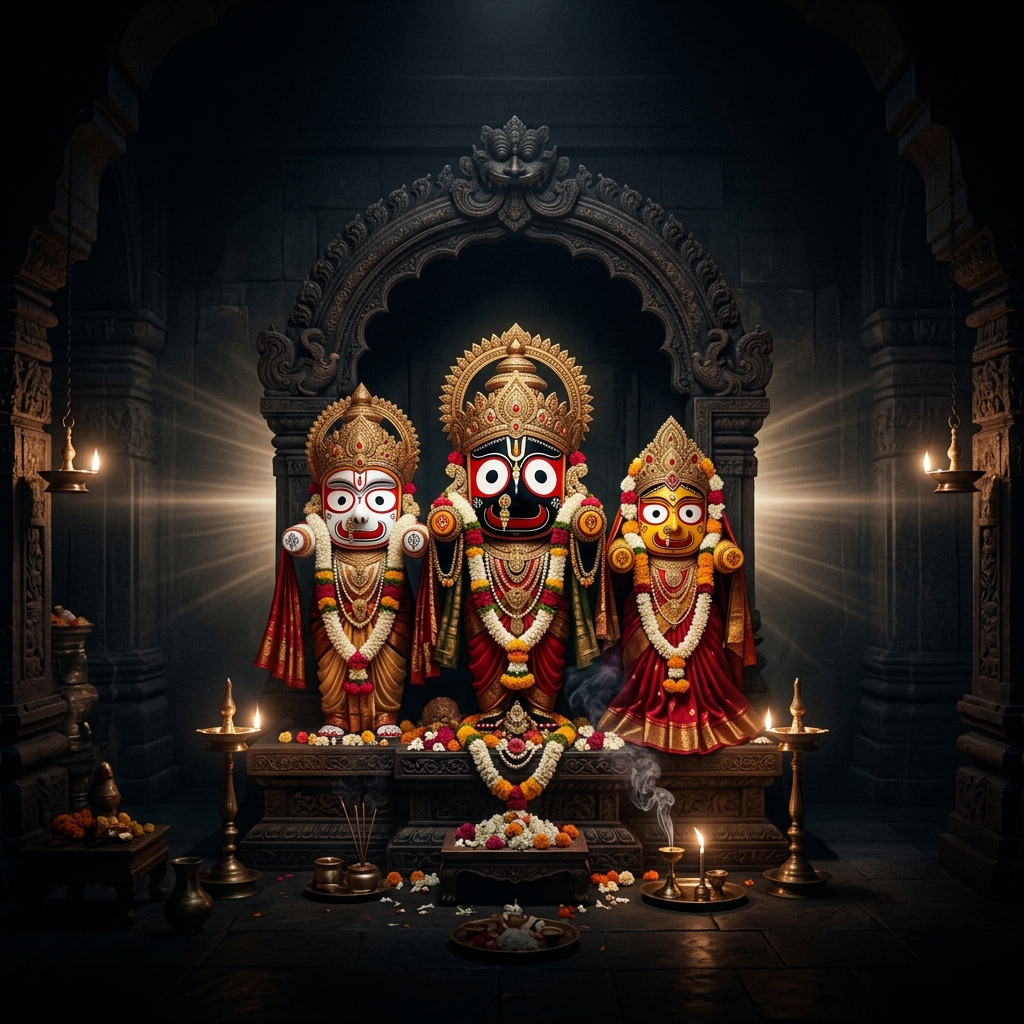
At the very core of Odia Vaishnava philosophy lies a concept that perfectly bridges the gap between the complex rituals of Hinduism and the absolute emptiness of Buddhism: the concept of Shunya Brahma, the Formless Void.
The Synthesis of Extremes
Historically, Odisha was a melting pot of various spiritual streams, including Shaivism, Shaktism, Mahayana Buddhism, and Vaishnavism. The genius of the Jagannath Tattva is how it assimilated these seemingly contradictory philosophies.
In mainstream Hinduism, God is often worshiped in a very specific, detailed physical form (Sagara or Saguna Brahma). In Buddhism, the ultimate reality is often described as Shunyata (Emptiness or Void). The Odia saints, particularly the Panchasakha, merged these ideas to declare Lord Jagannath as Shunya Brahma - the Void that is simultaneously the Supreme Reality.
A Formless Form
How can a physical, wooden deity be formless? If you look at the idol of Lord Jagannath, it is deliberately incomplete. He has no ears, no hands (only stumps), and no legs. He is described in the Upanishads as:
"He has no hands or feet, yet he grasps and moves rapidly. He has no eyes, yet he sees all. He has no ears, yet he hears everything."
His "incomplete" physical appearance is a philosophical statement. It reminds the devotee that the true nature of the Divine cannot be contained within the limits of human anatomy or comprehension. He is the infinite void (Shunya) taking a temporary, symbolic wooden form for the sake of the devotee.
The Search for the Void
The Panchasakha taught that the ultimate goal of a spiritual seeker is to realize this Shunya Brahma within themselves. The external worship of Lord Jagannath is a stepping stone to internal realization. True meditation, they argued, involves silencing the mind and dissolving the ego until nothing is left but the pure, luminous void - the true essence of the Lord of the Universe.