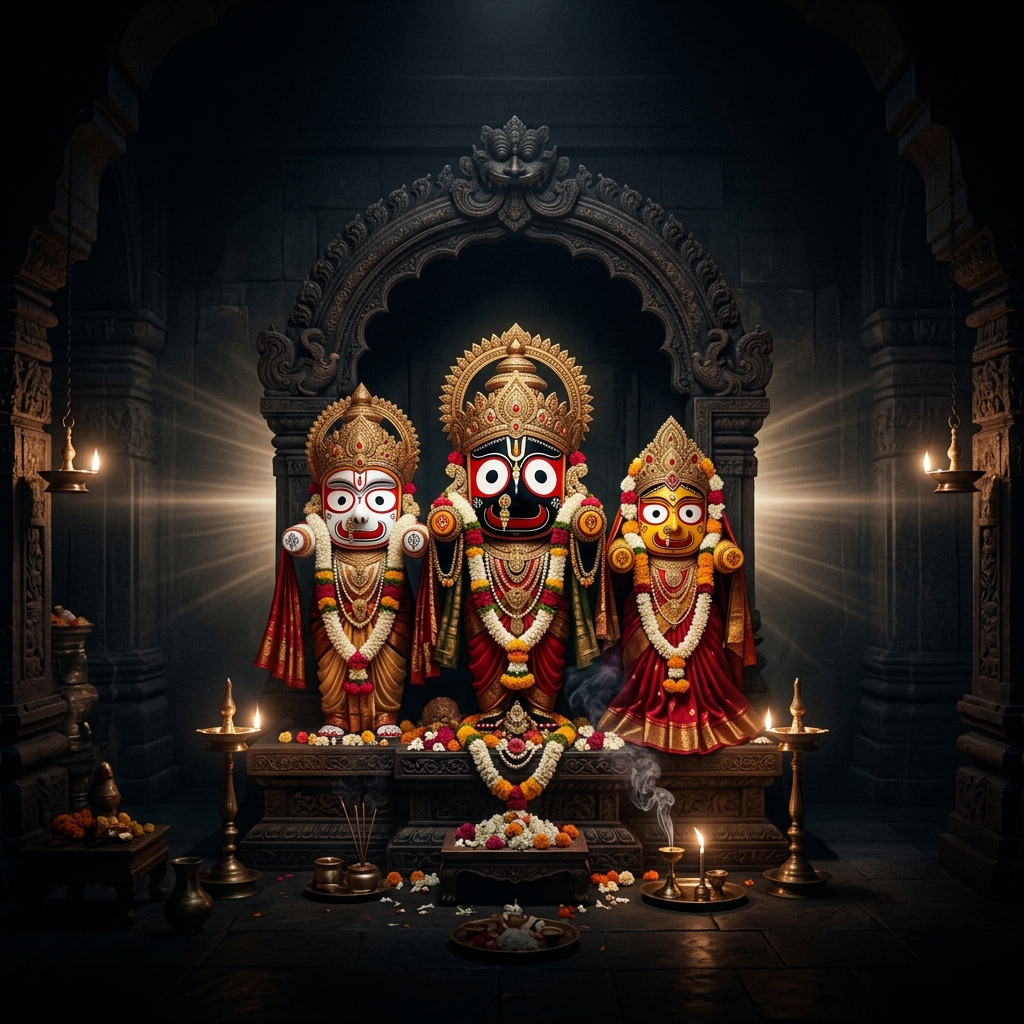
During the 15th and 16th centuries, the spiritual and literary landscape of Odisha witnessed a massive renaissance spearheaded by five great visionary poet-saints, collectively known as the Panchasakha (The Five Friends). They were Balarama Dasa, Jagannatha Dasa, Achyutananda Dasa, Ananta Dasa, and Jasobanta Dasa.
Translating the Divine
Before the Panchasakha, spiritual knowledge in the form of the Vedas, Upanishads, and Puranas was locked in Sanskrit, controlled by orthodox Brahmins. The Panchasakha undertook the revolutionary task of translating these complex spiritual truths into the local Odia language, making them accessible to the common masses.
The most famous of these works is the Odia Bhagavata written by Jagannatha Dasa. It became so incredibly popular that a copy of the book was placed and worshiped in almost every village in Odisha in a dedicated room known as the Bhagabata Tungi.
The Yogic Philosophy of the Panchasakha
While Chaitanya Mahaprabhu (their contemporary) emphasized pure, emotional Bhakti (devotion), the Panchasakha propagated a unique blend of Bhakti, Jnana (knowledge), and Yoga. They were deeply influenced by Buddhist Tantra, Nathism, and Vaishnavism.
In their philosophy, Lord Jagannath was not just the Avatar of Krishna; He was the Avatari (the source of all Avatars). They viewed the physical form of Lord Jagannath as a manifestation of the highest cosmic reality. Their literature heavily features esoteric concepts like Pinda-Brahmanda Tattva (the macrocosm within the microcosm of the human body), asserting that the true temple of Jagannath is within oneself.
The Legacy of the Five Friends
The Panchasakha wrote cryptic and prophetic texts, such as the Malika by Achyutananda Dasa, which details predictions about the Kali Yuga. Their poetry, hymns, and treatises formed the philosophical backbone of the Odia identity. They democratized religion, challenged orthodox gatekeeping, and forever cemented Lord Jagannath as the supreme, all-encompassing reality in the hearts of the Odia people.