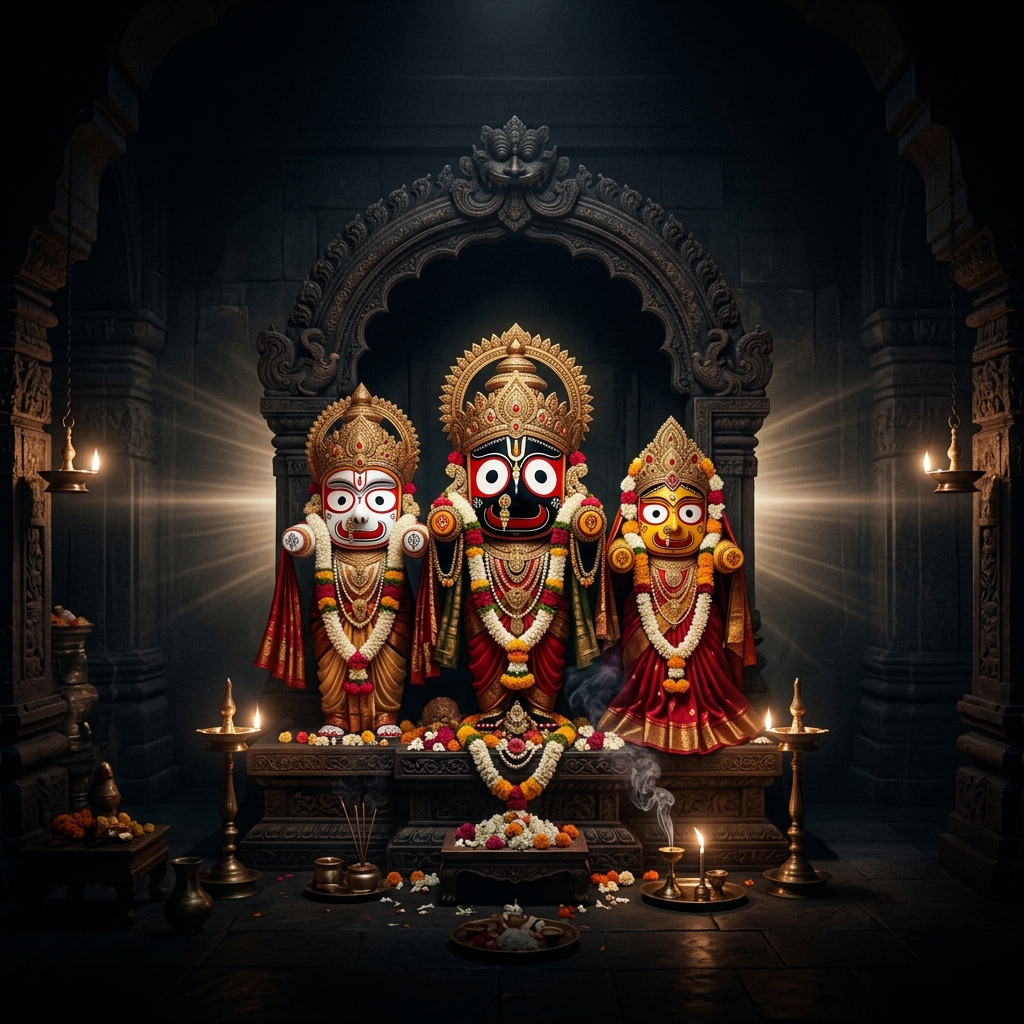
The cult of Lord Jagannath is deeply rooted in egalitarianism, a stark contrast to orthodox practices that often restricted temple entry based on caste, creed, or religion. The ultimate manifestation of this boundless compassion is Patita Pavana, which literally translates to "The Purifier of the Fallen."
The Lord at the Lion's Gate
If you visit the Shree Mandira in Puri, right at the main entrance known as the Singha Dwara (Lion's Gate), you will find a smaller replica of Lord Jagannath positioned on the right side. This deity is known as Patita Pavana.
Historically, non-Hindus, foreigners, and members of so-called "lower castes" were barred from entering the inner sanctum of the main temple. However, Lord Jagannath, whose very name means the "Lord of the Universe," could not be confined to a select few. The idol of Patita Pavana was installed specifically so that those who could not enter the temple could still catch a glimpse of the Lord from the Grand Road (Bada Danda) and receive His grace.
The Story of Salabega and Ramachandra Deva
The concept of Patita Pavana is intricately linked to several historical and legendary figures. One prominent connection is with King Ramachandra Deva of Khurda. Due to political alliances and forced circumstances, he was compelled to marry a Muslim princess, which led to his ostracization from orthodox Hindu society and a ban on his entry into the temple. Overcome with grief, he prayed to the Lord. To answer His devotee's prayers, the idol of Patita Pavana was installed so the king could worship from outside.
Another legendary figure is the Muslim poet Salabega. Prevented from entering the temple due to his parentage, Salabega composed some of the most heart-wrenching and deeply devoted Odia hymns (Bhajans) dedicated to Jagannath. It is said that Patita Pavana stands at the gate waiting for devotees like Salabega.
The Theological Implications
Theologically, Patita Pavana represents the ultimate accessibility of the divine. In Jagannath Tattva, God is not a distant, pure entity sitting in judgment, accessible only to the ritually pure. Instead, God is actively seeking to uplift the marginalized, the rejected, and the "fallen."
The existence of Patita Pavana ensures that the boundaries drawn by human society are erased by divine grace. The Lord comes to the threshold to meet those who are not allowed inside. This philosophy transforms the Jagannath tradition from a regional sect into a universal message of brotherhood and unconditional love.