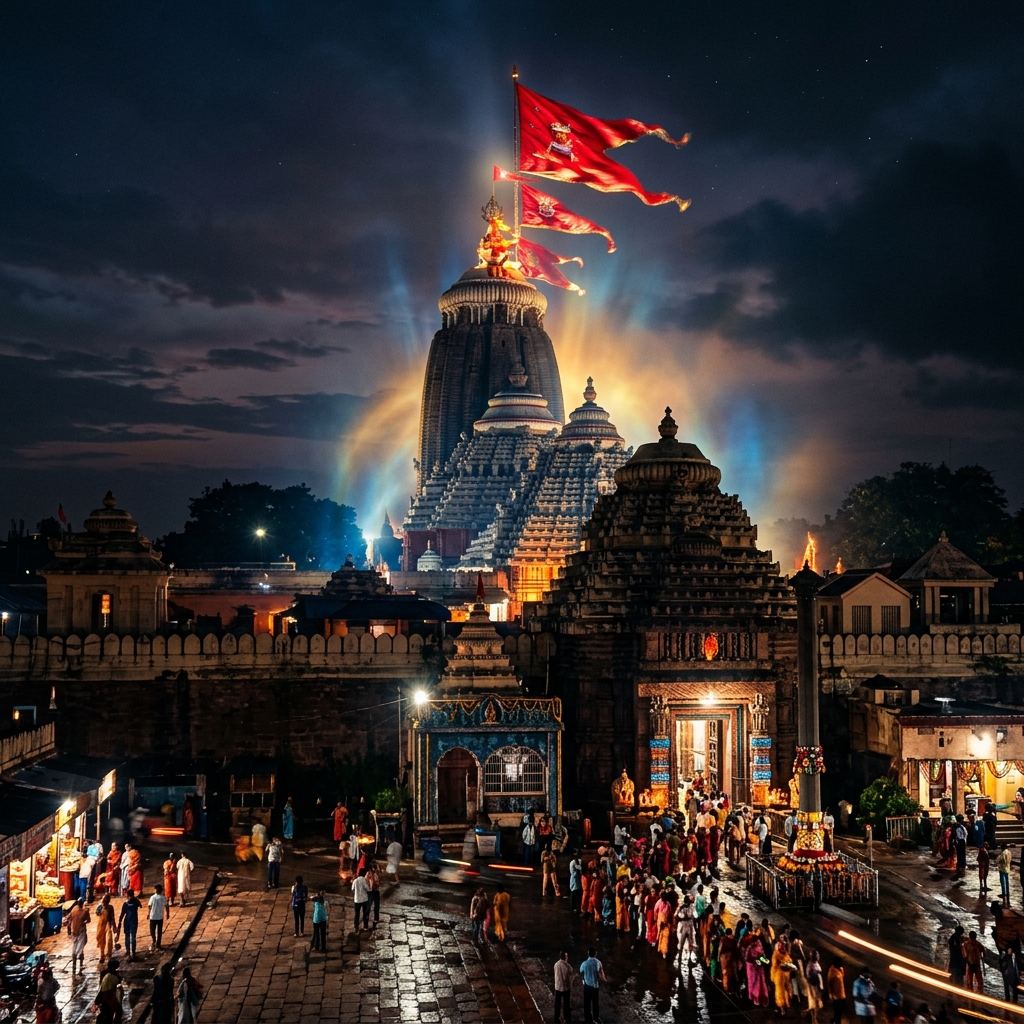
The Shree Jagannath Temple is not merely a place of worship; historically, it has served as a fortress. The entire temple complex, covering over 400,000 square feet, is enclosed by two massive concentric walls. The outermost and most imposing of these is the Meghanada Pacheri.
The Roar of the Clouds
The name Meghanada translates to "The Roar of the Clouds." This name is highly descriptive of the wall's acoustic properties. Puri is located right on the coast of the Bay of Bengal, and the roar of the ocean waves is deafeningly loud on the beaches just a few kilometers away.
However, the moment a devotee steps through the Singha Dwara (Lion's Gate) and crosses the threshold of the Meghanada Pacheri, a sheer architectural miracle occurs: the sound of the ocean completely vanishes. The wall acts as a massive sound barrier, cutting off the chaotic noise of the external world (Samsara) and plunging the devotee into an atmosphere of deep, spiritual silence.
A Wall of Defense
Constructed much later than the main temple, during the reign of the Gajapati King Kapilendra Deva in the 15th century, the Meghanada Pacheri was built primarily for defense. During this period, the temple faced frequent threats of invasion and plunder from neighboring kingdoms and sultanates.
The wall measures approximately 665 feet in length and 640 feet in width. Its height varies between 20 to 24 feet, and its thickness is an incredible 20 feet. It is built entirely of laterite and sandstone blocks, interlocking perfectly without the use of modern cement. Its sheer size and strength protected the sacred deities, the immense wealth of the temple treasury, and the lives of the servitors during times of siege.
The Four Gates
The Meghanada Pacheri is pierced by four massive gates facing the four cardinal directions, each guarded by a symbolic animal:
- East: Singha Dwara (Lion's Gate) - The main entrance, symbolizing Moksha (liberation).
- South: Ashwa Dwara (Horse's Gate) - Symbolizing Kama (desire).
- West: Vyaghra Dwara (Tiger's Gate) - Symbolizing Dharma (duty).
- North: Hasti Dwara (Elephant's Gate) - Symbolizing Artha (wealth).
These gates not only served as fortified entrances but also represented the four goals of human life in Hindu philosophy. The Meghanada Pacheri stands today as a testament to the Kalinga empire's engineering prowess, silently guarding the Lord of the Universe just as it has for over five centuries.