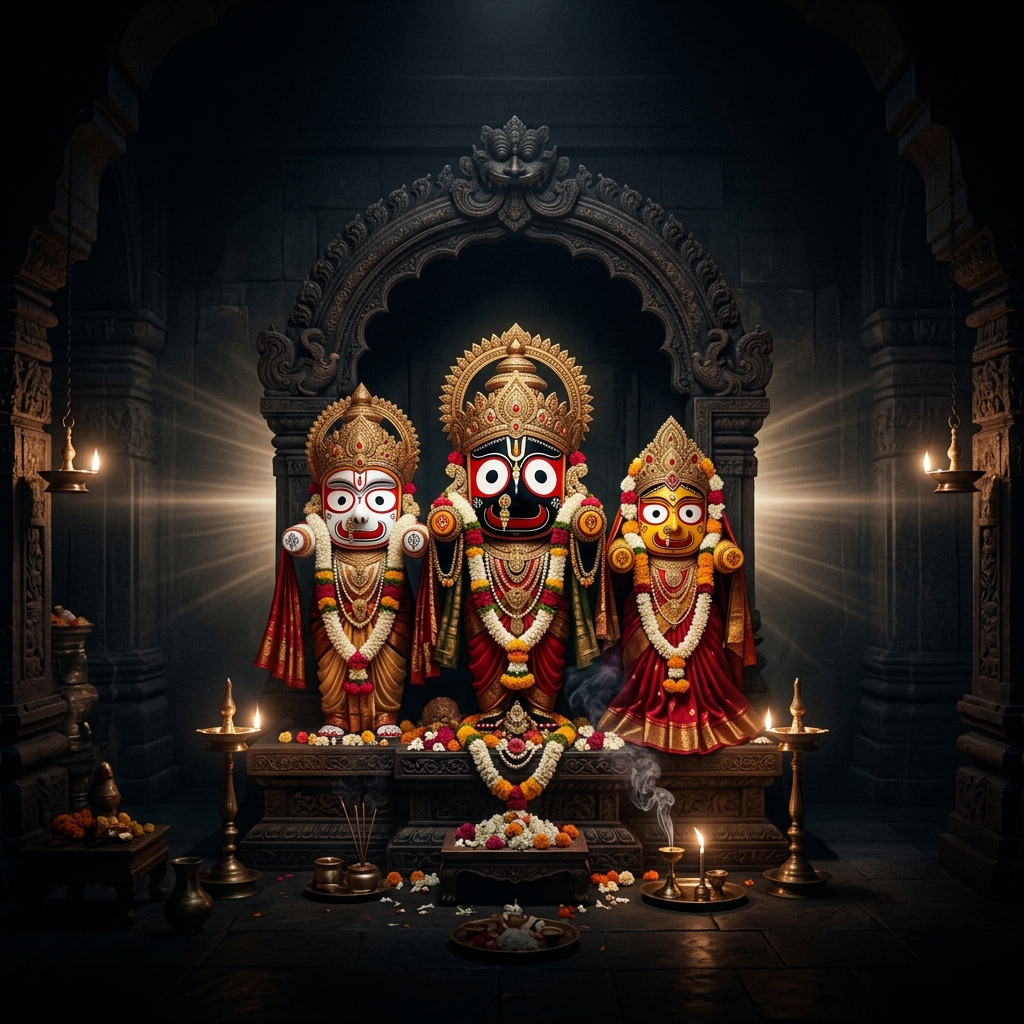
The most secretive, emotionally turbulent, and highly anticipated ritual in the Jagannath calendar is the Navakalebara (the changing of the physical bodies of the deities). Because the deities are made of wood (Daru), they are subject to natural decay. Depending on the occurrence of the Adhik Maas (an extra month) in the Hindu month of Ashadha, the deities receive new wooden bodies every 12 to 19 years.
The entire process begins with an incredible, mystic journey: the search for the sacred Neem trees (Margosa) from which the new deities will be carved.
The Journey to Kakatpur
The search party, known as the Banajaga Yatra, consists of specific hereditary servitors: the Daitapatis (descendants of the tribal king Vishwavasu), the Pati Mahapatras (descendants of the Brahmin Vidyapati), and the temple carpenters (Maharanas).
Their first destination is the temple of Goddess Mangala in Kakatpur. The tradition dictates that the servitors must sleep inside the temple and wait for the Goddess to appear in a dream to the head servitor. In this dream, the Goddess reveals the exact geographical direction and location of the four specific Neem trees meant for Lord Jagannath, Lord Balabhadra, Devi Subhadra, and Lord Sudarshana.
The Specific Signs of the Daru
The search is notoriously difficult because the servitors cannot just cut down any Neem tree. The trees must possess highly specific, miraculous signs (Lakshana):
- The tree for Lord Jagannath must be dark in color, while the one for Balabhadra should be light.
- The tree must have four main branches.
- It must be located near a river, a cremation ground, and a three-way intersection.
- There must be a Shiva temple nearby.
- The tree must not have any bird nests on it.
- There should be an anthill at the base of the tree, and a cobra must be seen protecting it.
- The trunk of the tree must naturally bear the impressions of the divine symbols: the conch, discus, mace, and lotus.
The Sacred Harvest
Once a tree matching these exact descriptions is found, the area is cordoned off. The servitors live near the tree for several days, performing complex Vedic fire sacrifices (Yajnas) to purify the area.
When the time comes to cut the tree, a specific golden axe is used first by the Pati Mahapatra, followed by a silver axe by the Daitapati, and finally iron axes by the carpenters. The massive logs (Daru Brahma) are then loaded onto specially constructed wooden carts and pulled entirely by human devotees - no animals are used - all the way back to the Shree Mandira in Puri, amid massive crowds chanting the Lord's name.