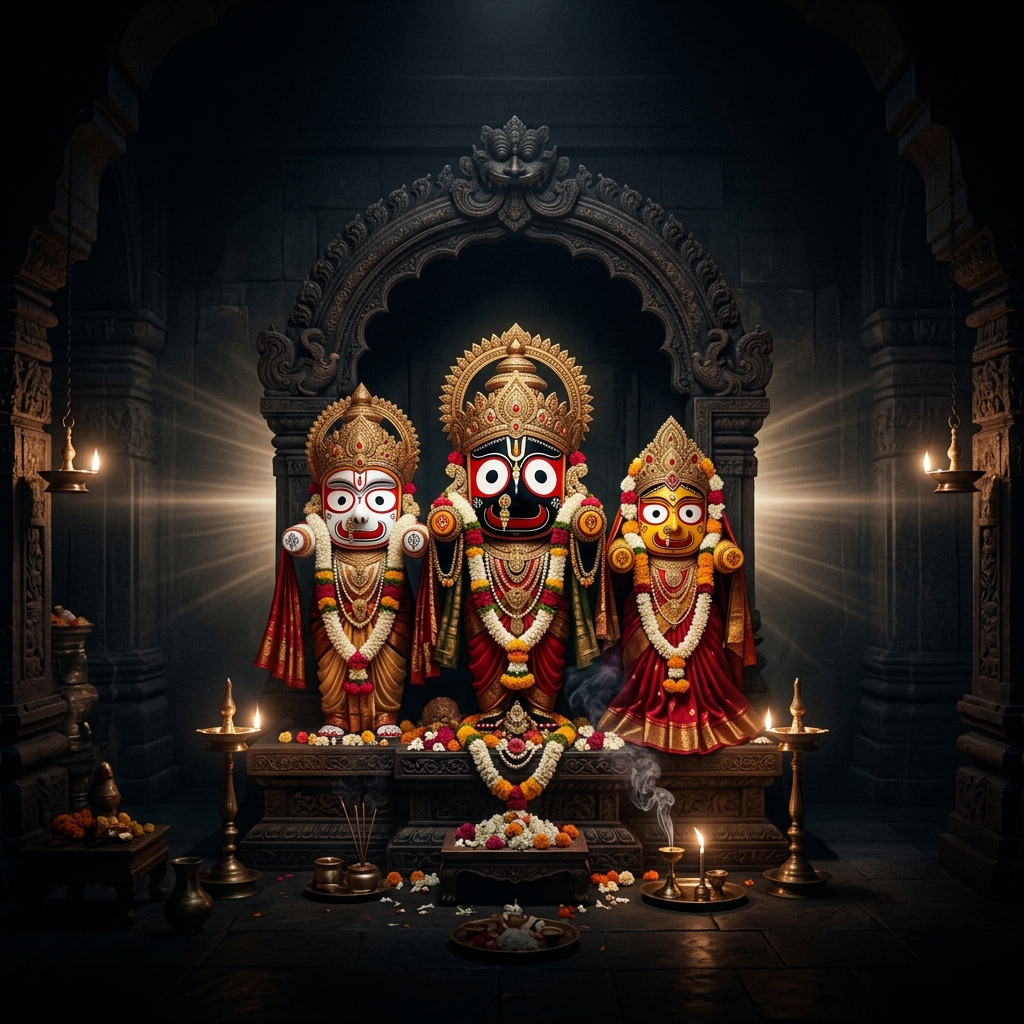
A central tenet of the Jagannath Tattva is the belief that the Lord of the Universe resides in Puri specifically to eat. While He bathes in Rameswaram, sleeps in Dwarka, and meditates in Badrinath, He dines in Puri. Therefore, the daily menu of the Lord is an affair of unparalleled culinary grandeur, famously known as the Chhapana Bhoga (The mahaprasad|56 Offerings]]).
The Origin of the 56 Offerings
The concept of 56 offerings is deeply rooted in Vaishnava mythology, specifically tied to Lord Krishna. When Krishna lifted the Govardhan Hill on his little finger to protect the villagers of Vrindavan from the wrath of Indra, he stood continuously for seven days without eating.
Normally, Krishna ate eight meals a day. Thus, after the seven-day ordeal, the villagers calculated that he had missed 56 meals (7 days x 8 meals). Out of immense love and gratitude, they prepared 56 distinct dishes and offered them to Him in a grand feast. This tradition is immortalized in the daily worship of Lord Jagannath.
The Categories of the Bhoga
The 56 items are not random; they are meticulously categorized based on their preparation method and ingredients. They are broadly divided into:
- Anna (Rice Dishes): Includes plain rice, sweet rice (Kanika), ghee rice (Ghia Anna), and lemon rice.
- Dali & Dalma: Various lentil soups and the famous Odia Dalma (lentils cooked with vegetables).
- Pitha (Baked & Fried Cakes): Includes Poda Pitha (baked cake), Kakara (deep-fried sweet), and Arisa.
- Mitha (Sweets): Includes Rasagola, Khaja (a flaky, layered pastry), Chenna Poda, and Malpua.
- Besara & Mahura: Unique vegetable curries. Besara is characterized by its strong mustard paste flavor.
- Saga: Various leafy green preparations.
The Strict Culinary Rules
The preparation of the Chhapana Bhoga is governed by incredibly strict rules.
- No Foreign Ingredients: Items not native to ancient India, such as potatoes, tomatoes, green chilies, cabbage, and refined sugar, are strictly forbidden. The kitchen relies entirely on indigenous vegetables, roots, black pepper, and jaggery.
- Purity: The food is cooked exclusively in kudua-earthen-pots|earthen pots]] (Kudua) using wood fires.
- The Timing: The offerings are divided into several meals throughout the day, the most prominent being the Gopala Vallabha Bhoga (morning breakfast), Sakhala Dhupa (morning meal), Madhyahna Dhupa (midday meal), and Sandhya Dhupa (evening meal).
The Chhapana Bhoga is not just a menu; it is a meticulously preserved edible archive of ancient Indian culinary science, saturated with the ultimate ingredient: devotion.