What is Daru Brahma?
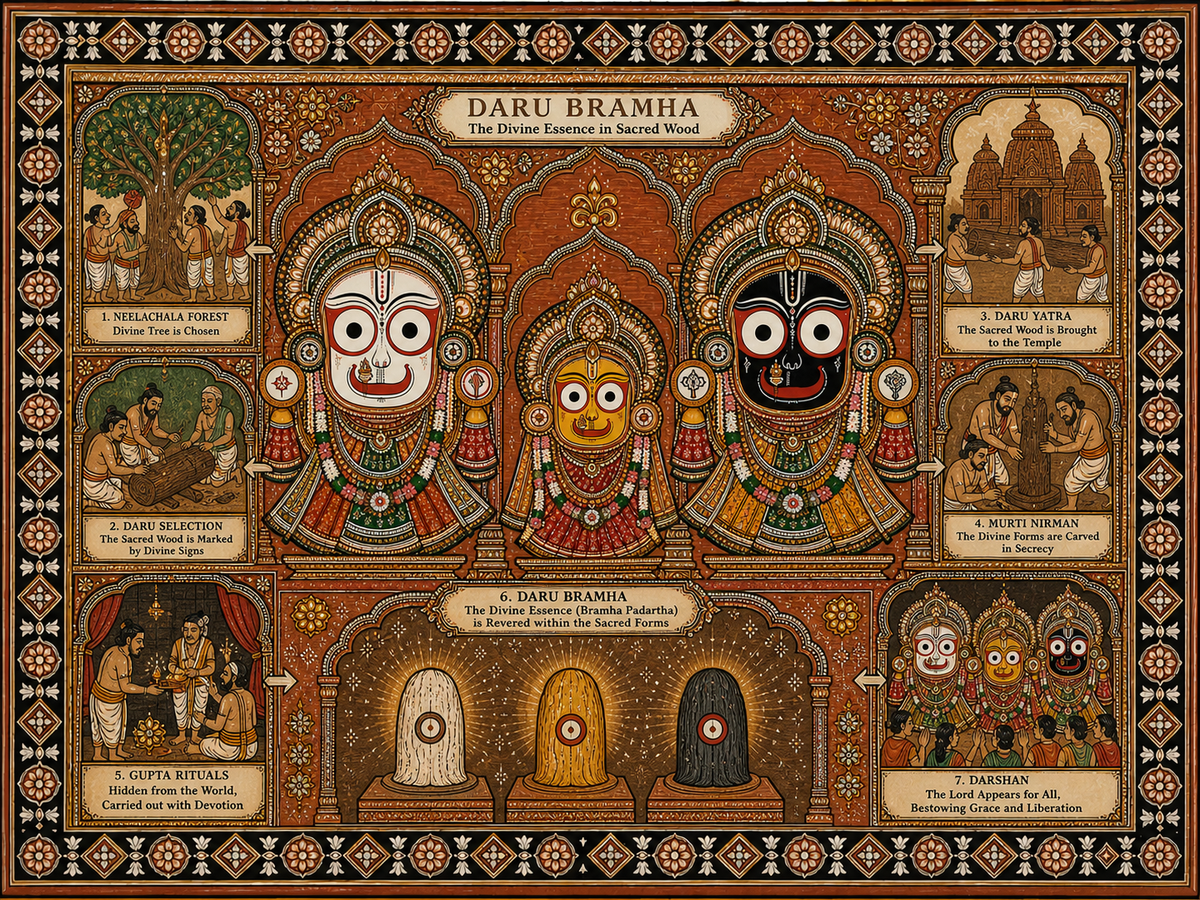
Daru Brahma is one of the most mysterious and central ideas in the tradition of Jagannath.
It is often described as the “core essence” placed inside the wooden idols of Jagannath, Balabhadra, and Subhadra.
But beyond that, clarity fades.
There is no detailed explanation, no clear description, and no universally accepted definition.
And that is what makes it so powerful.
The meaning behind the name
“Daru” means wood.
“Brahma” refers to the ultimate reality or divine essence.
When you bring these two together, Daru Brahma points to something deeper than the physical structure of the idol.
It suggests that what we see is not the whole story.
There is something within. Something that gives presence, meaning, and continuity.
Not just a form, but a living idea.
The connection with Nabakalebara
Daru Brahma becomes especially important during Nabakalebara, the ritual where the idols are replaced with new ones.
This is not a simple replacement. It is a transformation.
During this process, the existing Daru Brahma is transferred from the old idols to the new ones.
This moment is treated with extreme secrecy.
Only a very small group of priests are allowed to perform the ritual. Even they follow strict conditions, often blindfolded, ensuring that the process remains unseen and undocumented.
There is no public record of what exactly is transferred.
No description. No visual proof.
Only continuity.
Why it remains unknown
There is no confirmed explanation of what Daru Brahma physically is.
Some believe it is a sacred object hidden within the idols.
Some interpret it as a symbolic representation of divine presence.
Others believe it cannot be defined in physical terms at all.
But what stands out is this.
The tradition does not try to resolve this uncertainty.
It does not attempt to explain everything.
And that feels intentional.
What Daru Brahma represents
Daru Brahma shifts your attention from the outer form to the inner essence.
The idol changes. The wood is replaced. The visible structure evolves over time.
But something continues without interruption.
That continuity is what Daru Brahma represents.
It brings up a deeper question.
Is the divine in the form itself, or in what the form carries?
And if the form can change, what is it that truly remains?
Why the mystery matters
In many traditions, there is a strong effort to define, explain, and categorize everything.
Here, something is deliberately left open.
That absence of a clear answer is not a weakness. It is part of the design.
It creates space for reflection.
It allows each person to engage with the idea in their own way.
Not everything needs to be fully understood to be meaningful.
Daru Brahma quietly reminds us of that.
A different way to see it
You can approach Daru Brahma in two ways.
You can see it as something sacred that must be accepted without question.
Or you can see it as an idea that invites you to think beyond what is visible and measurable.
Jagannath Tattva does not force you into one perspective.
It leaves room for both.
And maybe that openness is the point.
Comments ()